Πρόσφατο Βιβλίο
pdf
Λογοτεχνικά Έργα & Παρουσιάσεις

Art Geopolitics Review

Efstratios Zikopoulos
International Hospitality specialist and expert in Geopolitiscs and International Relations
Zikopoulos Efstratios
PhD Candidate in Geopolitics
MSc Geopolitics and International Security
National and Kapodistrian University of Athens Athens,
3/1/2025
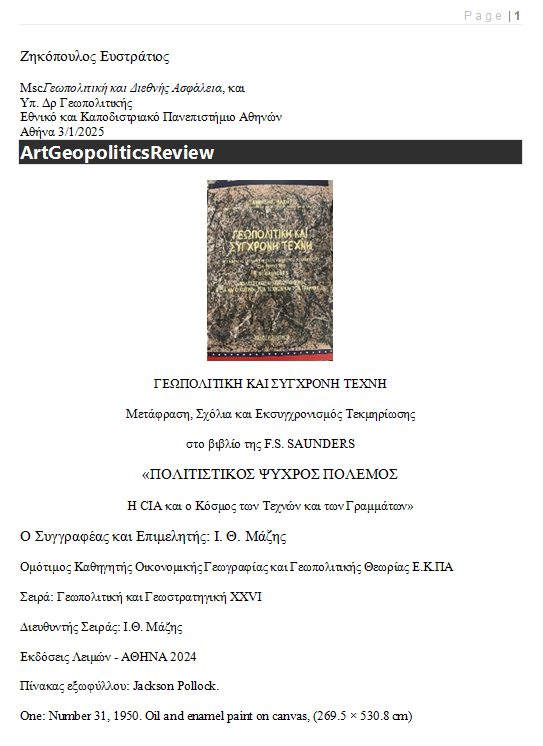
GEOPOLITICS AND CONTEMPORARY ART
Translation, Commentary, and Documentation Modernization on the book by FRANCES STONOR SAUNDERS «The Cultural Cold War The CIA and the World of Arts and Letters» (in Greek)
author and curator: I. Th. Mazis
Editor: I.Th. Mazis Leimon Publications – ATHENS 2024
Cover Artwork: Jackson Pollock
One: Number 31, 1950. Oil and enamel paint on canvas, (269.5 × 530.8 cm)
Book Review:
The way to carry out good propaganda is never to appear to be carrying it out at all.
Richard Crossman
The book “Contemporary Art and Geopolitics”, (in Greek), offers an original and highly substantiated approach to the relationship between aesthetic creation and international strategies. The author, known for his rationalism and mathematical mindset, delves into a subject traditionally perceived through the lens of subjectivity and emotion: Art. However, his perspective does not focus on the nature or essence of artistic creation but on how Art is manipulated and instrumentalized within geopolitical contexts.
Based on his theory of Systemic Geopolitical Analysis, which relies exclusively on measurable, demonstrable data, the author incorporates Art into the Cultural Pillar of Geopolitics, alongside Religions and Propaganda. His central argument is that contemporary art, rather than being an independent expression of creativity, often functions as a tool for ideological direction, social engineering, and political influence. His study highlights cases in which art has been strategically employed to construct narratives, promote cultural hegemonies, and reinforce specific geopolitical agendas.
Of particular significance is the methodological rigor of the author. By integrating data, statistical analyses, and diachronic comparisons, he deconstructs the romanticized notion of art as a purely personal and spiritual expression. He presents cases where state entities, institutions, and economic elites have supported or promoted specific artistic movements to achieve political or economic goals.
One of the most intriguing aspects of the work is that, despite his strictly scientific approach, the author does not dismiss artistic creation but seeks to rationalize it. As a visual artist and poet, himself, he understands the power of emotions but chooses to approach them with the tools of analysis and structured thought. This dual perspective gives the book a distinctive character, bridging the gap between science and art.
In conclusion, “Contemporary Art and Geopolitics” represents a significant contribution to the field of cultural geopolitics. It offers a well-documented and critical perspective on the use of art as a tool of power, avoiding both excessive aestheticization and absolute cynicism. This work is addressed not only to academics in social and political sciences but also to artists, art historians, and readers who seek to understand the interaction between aesthetics and strategic thinking in the modern world.
Professor Mazis points out that
“This does not, of course, mean that we dismiss artistic evolution and its morphological expressions. We do not place blame on Contemporary Art per se. However, we prefer and choose that the quality of Art and the artistic work produced be what makes an artist renowned, rather than some intelligence agency operating under the guise of its own construct, which in this case is the Congress for Cultural Freedom—with its ‘organized collaborators’ (Museums, Galleries, Orchestras, International Exhibitions, and enormous sums from ‘collectors’ who keep the artwork they purchased for an average of 33 days (!) before reselling it).”
Besides,
“the author and curator of this work holds a perspective on the Visual Arts (as a student at the Athens School of Fine Arts and through his engagement with the diverse and differing views of his esteemed Teachers/Colleagues), without claiming to ‘rightly divide the Word of Truth,’ but rather aiming to contribute to a reflective discussion with serious historical evidence regarding contemporary developments in the field of Art.”[1]
[1] From the preface of the book.
Λογοτεχνία
1. Yiannis Th. Mazis (Γιάννης Θ. Μάζης), Κρυπτικά Ημερολόγια της Νήσου Σολέμνις και των εν αυτή ευρισκομένων θαυμαστών Ανθέων και Φυτών: Συνταχθέντα υπό Διονυσίου του Απωλολότος και σχολιασθέντα υπό του Μαθητού Αυτού Ιωάννου του Παυλικιανού, (Cryptic Diaries of the Isle Solemnis and of the thereon wonderful Flowers and Plants: Compiled by Dionysos the Lost and commented upon by his disciple Ioannis the Paulician), Έψιλον (Έψιλον), Αθήνα 2004, ps: 46.
2. Yiannis Th. Mazis (Γιάννης Θ. Μάζης), Ο Ιούλιος και το Γκόλεμ και κάποια άλλα μικρά κείμενα, (Julius and the Golem, and some other short stories) A collection of short stories, texts and essays, Confessio/Papazisis Publications (Confessio/Εκδόσεις Παπαζήση), Αθήνα 2005, ps: 123.
3. Yiannis Th. Mazis (Γιάννης Θ. Μάζης), Τρείς μικρές ιστορίες από την Βαγδάτη, (Three short stories from Bagdad), Confessio/Papazisis Publications (Confessio/Εκδόσεις Παπαζήση), Αθήνα 2005, ps: 40.
4. Yiannis Th. Mazis (Γιάννης Θ. Μάζης), Ιωάννου του Ηρακλεικού: Αμεθύστη η έκπαγλος, Χρονικόν μέγα και μυστικόν, (Ioannou of Herakleikos: Amethyste i Ekpaglos. Chronikon Mega kai Mystikon (Amethysty Mirabillis), Chronicle great and secret), Confessio/Papazisis Publications (Confessio/Εκδόσεις Παπαζήση), Αθήνα 2014, ps: 166.
5. Ioannis Th. Mazis, Ιωάννου του Ηρακλεικού: Αμεθύστη η έκπαγλος, Χρονικόν μέγα και μυστικόν, (Ioannou of Herakleikos: Amethyste i Ekpaglos. Chronikon Mega kai Mystikon (Amethysty Mirabillis), Chronicle great and secret), Leimon Eds/Εκδόσεις Λειμών, Αθήνα 2023, ps: 166.
Ατομικές εκδόσεις ποιημάτων και πεζογραφίας
1. Yiannis Th. Mazis, (A Poem in Eight Parts), Επτά και μία Variations/Epta kai mia Variations (Seven and one Variations), Πόρφυρας/Porfyras, no. 76, Corfu, January-March 1993, pp: 169-170.
2. Yiannis Th. Mazis, (Poem), Μέγα Σάββατο/Mega Savato (Great Saturday), Πόρφυρας/Porfyras, no. 76, Corfu, January-March 1993, p: 171.
3. Yiannis Th. Mazis, (Poem), Πάσχα Κυρίου/Pascha Kyriou (Our Lords Easter), Πόρφυρας/Porfyras, no. 76, Corfu, January-March 1993, p: 171.
4. Yiannis Th. Mazis, (Poem), Τας πέριξ του Ευξείνου…Μέμνησο…/Tas perix tou Eyksinou…Memniso…, (In the Vicinity of the Pontus Euxinus…remember), Πόρφυρας/Porfyras, no. 66, Corfu, July-October 1993, pp: 57-58.
5. Yiannis Th. Mazis, (A Poem in Six Parts), Emmenontes … oi monoi… os memyimenoi (Remaining… alone… as initiated), Πόρφυρας/Porfyras, no. 70, Corfu, July-September 1994, pp: 303-304.
6. Yiannis Th. Mazis, (Poem), No te engañes corazon…[Carlos Gardel], Tetramina (Editor in chief-Director: Drosos Kravartoyiannos), no. 59-61, Winter ’97-98, pp: 4585-4586.
7. Yiannis Th. Mazis, (Poem), Αντεστραμένο ρούχο/Antestrameno roucho (reversed clothes), Tetramina (Editor in chief-Director: Δρόσος Κραβαρτόγιαννος/Drosos Kravartoyiannos), no. 59-61, Winter ’97-98, p: 4587.
8. Yiannis Th. Mazis, (Text/ Guidelines and Notes for two scenes), Αρχάγγελος και Γραίγος/Archaggelos kai Graigos (Archangel and North-Eastern Wind,) Tetramina, no. 59-61, Winter ’97-98, pp: 4588-4590.
9. Yiannis Th. Mazis, (Poem), Παιδικό της Κύπρος/Paidiko tis Kipros (Children’s song from Cyprus), 13-02-99, Pneumatiki Kipros, no. 395, pp: 104-105.
10. Yiannis Th. Mazis, Τρείς Μικρές Ισtορίες: Κέτερ, Χόκμα και Μπινά/Treis Mikres Istories: Keter, Hokma kai Bina (Three Short Stories: Keter, Hokma and Bina) (prose), Πόρφυρας/Porfyras, Vol. ΚΗ΄ (123-126), no. 125, Corfu, October-December 2007, pp: 487- 492.